Slotify.
Different resources,
coordinated bookings.
Rooms, instruments and laboratories at the University of Padua are booked through the same platform. Each department keeps its own rules, with pricing, charges and reporting handled by the system.
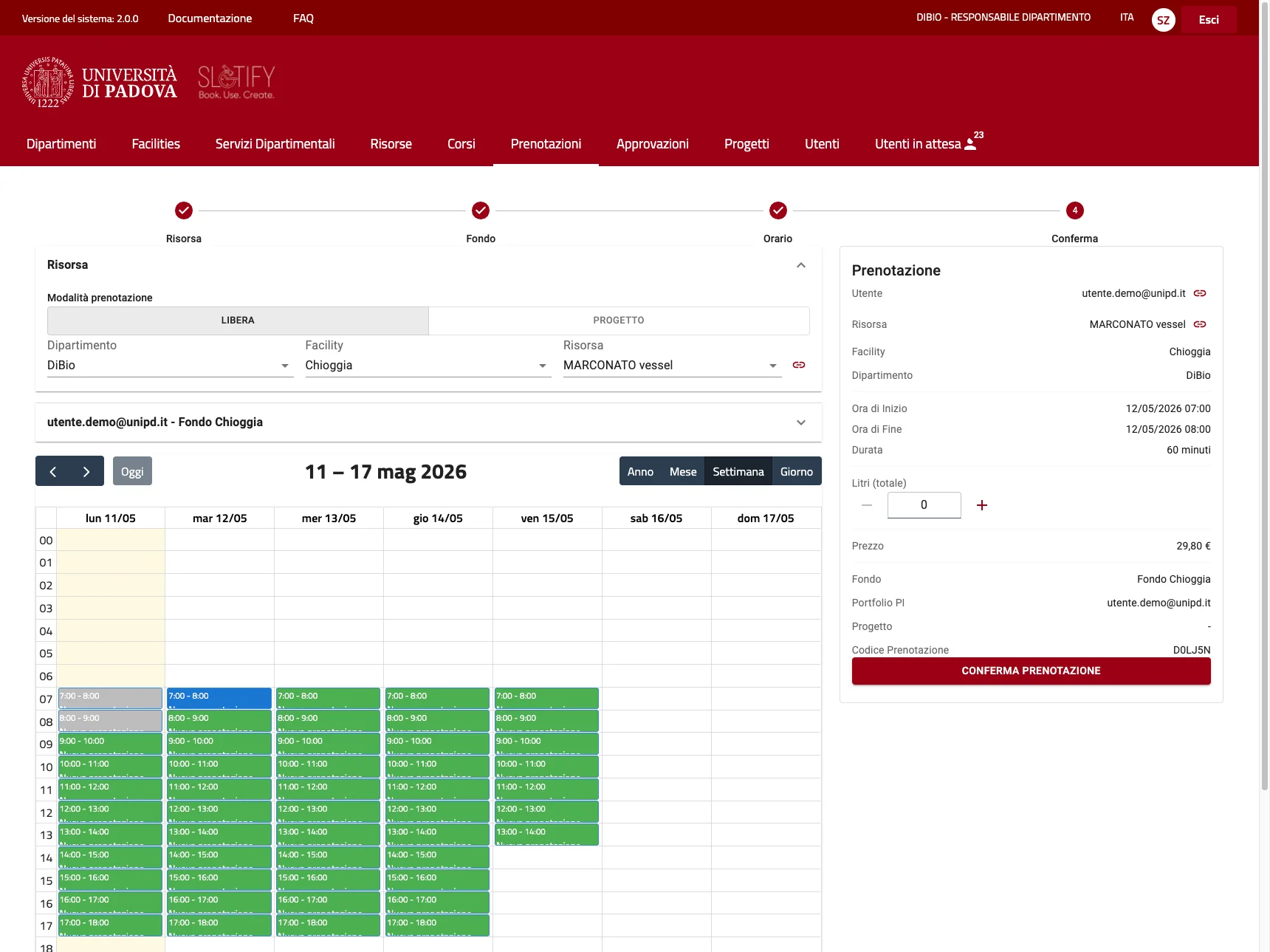
One interface
for wildly different resources.
Slotify centralizes booking for the University of Padua's shared resources: rooms, instruments, labs, equipment. Pricing tiered by user category, charges billed to research funds and projects, reporting back to central administration.
Where we
started.
Three departments, three different systems. Excel for rooms, email for labs, paper sheets for instruments. Rates applied from memory, reporting reconstructed at year-end. One shared service, a fragmented process.
The challenge
Unify booking for hundreds of heterogeneous resources — meeting rooms, electron microscopes, cleanrooms — without forcing one process onto departments with different rules. Rates for five user categories. Charges billed to research funds. Full audit trail for central administration.
Our approach
One platform, configurable per department. Identity derived from the university's SAML, rates calculated at login, approval rules chosen by the department manager. Demos every Friday, a first version in production within six weeks, continuous refinement with real users.
The result
A single source of truth for university-wide bookings. Three legacy systems replaced, automatic reporting to administration, a complete audit trail. The same system serves the meeting room and the electron microscope alike — the same experience for the person booking, different rules under the hood.
Four profiles,
one interface.
Each user group sees the information and actions allowed by its role and the department’s rules.
Researchers
& faculty
Book instruments and labs, charge to research projects, download reports.
Department
managers
Configure resources, pricing rules, approval thresholds, recurring calendars.
External
users
Companies, spin-offs, partner institutions. Dedicated rates and mandatory approval.
Central
administrators
Cross-departmental governance, audits, university-wide policy configuration, consolidated reporting.
What it does,
in practice.
Eight features for booking different resources, managing approvals and tracking costs and usage.
Exclusive resources
or shared places
A resource reserved for one person, or several places available in the same time slot.
Availability and
recurring schedules
Recurring hours, exceptions and maintenance periods determine when a resource can be booked.
Public
calendar, QR
Every resource has its own shareable calendar. A QR code to post on the door.
Multi-level
approvals
Configurable workflows: none, single, chain. Set by the department.
Pricing
by usage
Rates per hour, day, unit. Set on the resource, calculated at booking time.
Funds and
projects
Charges tracked to funds, budget caps, authorizations and named principal investigators.
Automatic
reminders
Email confirmations and reminders, in Italian and English.
Reporting
and transactions
Full history. Exports for administration, utilization rates for facility managers.
Three tiers,
one source of truth.
The user category is derived from SAML identity at login. No forms to fill in, no ambiguity about which rate applies.
Internal UniPD
Faculty and staff, researchers, PhD students, students. Reference rate.
Partner institutions
Partner universities, public bodies, spin-offs. Multiplier applied under an active agreement.
External users
Companies, professionals, private individuals. Mandatory approval.
University identity,
context-aware permissions.
Three layers sharing the same logic: identity decides who you are, CASL decides what you can do, JWT signs every request.
SSO
SAML 2.0
UniPD federation. No local accounts, identity lifecycle governed by the university.
Signed JWT
RSA-PSS
API tokens with asymmetric keys and probabilistic padding. Rotation is managed.
Permissions
via CASL
Five context-aware roles. Permissions evaluated at the level of a single object.
Tech stack.
Full-stack TypeScript, infrastructure-as-code deploys. Tools we choose, not collect.
Slotify centralizes booking for university resources: from the meeting room to the electron microscope.
Images are for illustrative purposes and do not necessarily reflect the current state of the application.